Are employee performance reviews still necessary?
Performance reviews haven't gone the way of the dodo — the annual “trial” has. What the data from Adobe, Deloitte, GE and Gallup says, and how to design reviews that support growth and retention.
Yes, but not in the form of an annual trial covering the whole year. A well-designed review still determines promotions, raises and skills development. What's heading for the scrapheap is the one-off, once-a-year ritual — replaced by a continuous process: ongoing feedback, goals, 1:1 meetings and multi-perspective reviews.
What are employee performance reviews and why do them?
A performance review is part of performance management. It gathers information about an employee's results, competencies and attitude and translates it into decisions: who gets a promotion, who gets a raise, who needs training, and who needs a change of role. It's a decision-making tool, not a ceremony.
A review serves several functions at once:
- Developmental – it points to competencies to strengthen and the next goals.
- Decision-making – it provides the basis for promotions, reassignments and pay decisions.
- Motivational – it confirms to the employee that their work is seen and measured against clear criteria.
- Retention-focused – it catches a drop in engagement before it ends in a resignation.
That last point matters most in the Polish context. Gallup's report “State of the Global Workplace: 2025” shows that just 8% of working Poles are engaged at work — one of the lowest results in Europe (for comparison, in Romania the figure reaches 35%). A company without reliable information about its people manages engagement by gut feeling, and gut feeling is expensive: according to Gallup's analyses, replacing a single person costs between 50% and as much as 200% of their annual salary.
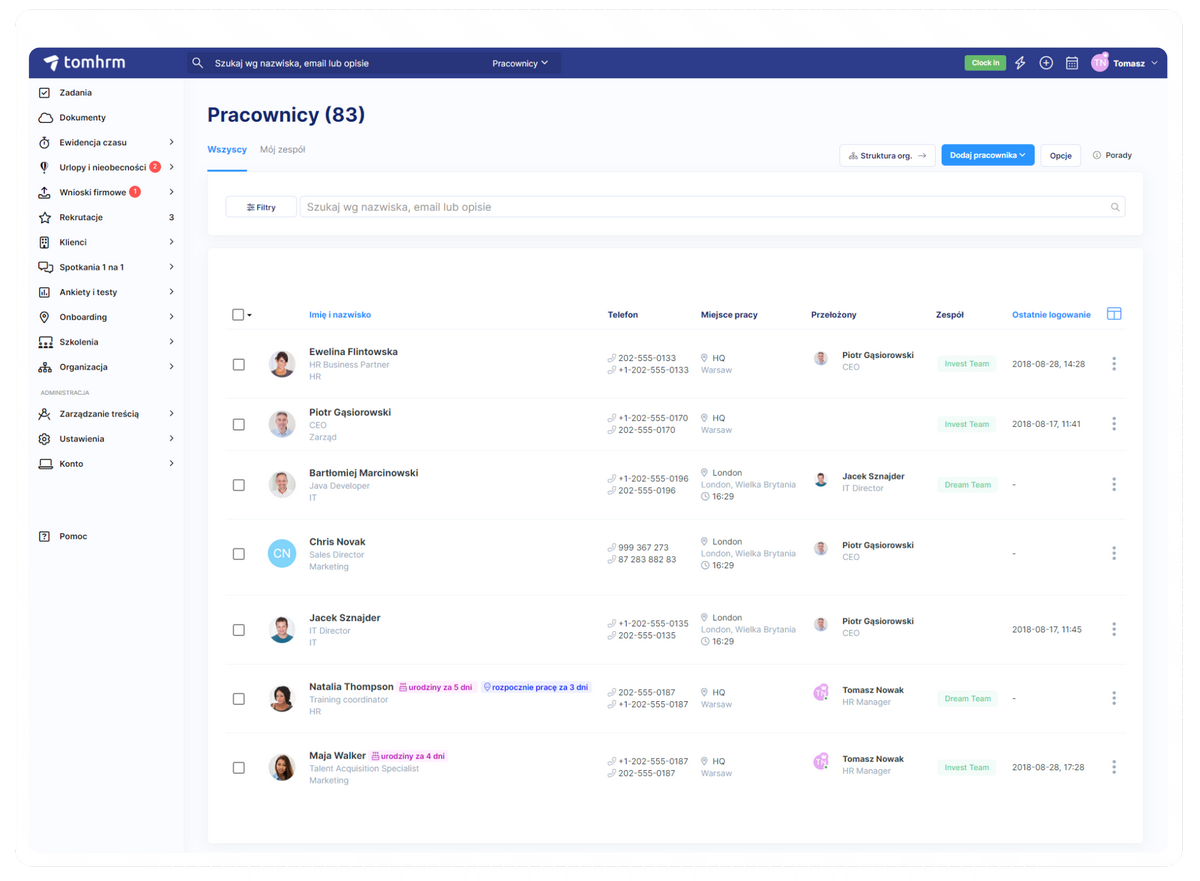
Consult your HR processes with us and see how tomHRM can help with performance reviews and 360° feedback.
Does the law require performance reviews?
As a rule, no. The Polish Labour Code does not impose an obligation on private-sector employers to carry out periodic reviews. The statutory obligation applies to selected professional groups — including civil service corps members and academic teachers — and there the criteria stem from separate acts.
There is, however, one condition worth remembering. If you do evaluate, Article 94(9) of the Labour Code (Journal of Laws 2025, item 277, consolidated text) requires the employer to “apply objective and fair criteria for evaluating employees and the results of their work.” In practice this means three things: the criteria must be known to the employee in advance, tied to their duties, and observable. On top of that, the employee has the right to review their appraisal and appeal against it to a labour court. An appraisal “for attitude” won't hold up in such a dispute; an appraisal “for meeting task deadlines” will.
Why is the annual review criticised?
Because in its classic form it measures the manager's memory, not the team's work. The data are merciless. According to Gallup (“Give Performance Reviews That Actually Inspire Employees”), only 14% of employees strongly agree that the reviews they receive inspire them to improve, and only two in ten feel motivated by the way their performance is managed. Just 29% consider reviews fair, and 26% accurate.
There are several reasons and they are all recurring:
- The halo and horn effects – one striking trait, positive or negative, spills over onto the assessment of all other competencies.
- Recency bias – the manager evaluates the last few weeks instead of the whole period.
- The idiosyncratic rater effect – the rating says more about the rater than the person being rated. Deloitte proved this mechanism in a controlled study of its own organisation.
- An annual cadence – feedback arrives when it's already too late to correct course.
On top of that comes the cost. Adobe estimated that traditional reviews consumed a total of 80,000 manager hours a year — the equivalent of nearly 40 full-time roles working all year round (Forbes, David Burkus, 1 June 2016). Deloitte calculated that filling in forms, meetings and producing ratings ate up close to 2 million hours a year in its organisation (Marcus Buckingham and Ashley Goodall, “Reinventing Performance Management,” Harvard Business Review, April 2015). That isn't an investment in development; it's a tax on procedure.
Who actually scrapped the annual review, and what came of it?
The debate about the “death of the annual review” rests on a few high-profile examples. They're worth reading carefully, because none of these employers abolished evaluation — each of them changed its form.
- Adobe (2012). It scrapped stack ranking and annual reviews in favour of “Check-ins” — frequent, lightweight conversations between manager and employee about goals, feedback and development. The result, according to the company's data: a 30% drop in voluntary turnover and 80,000 manager hours recovered per year. Involuntary departures rose by 50%, because difficult conversations stopped waiting until year-end (Forbes, CMI).
- Deloitte. Instead of an annual review it introduced a “performance snapshot” after each project, or quarterly for longer projects. The approach was described by Marcus Buckingham and Ashley Goodall in “Harvard Business Review” (April 2015). Instead of asking leaders what they think of an employee, they ask what they would do with them.
- General Electric. The company that made forced ranking famous replaced it with the PD@GE app and a system of ongoing “touchpoints” and short-term goals. The pilot covered 30,000 employees. As Susan Peters, VP of HR, said in a statement on 26 July 2015 (via Bloomberg), the system “without ratings was more motivating, and managers confirmed they were still able to make staffing decisions.”
The conclusion is consistent: the review didn't disappear — the once-a-year calendar and the rigid rating disconnected from the work did.
It's worth keeping a sense of proportion, though. This is a handful of high-profile case studies, not proof that every company should follow the same path. Some researchers warn against treating the abandonment of reviews as a “fad” and remind us that a model good for a tech corporation won't necessarily work in a manufacturing company. The key isn't to copy Adobe, but to understand why their old process was failing.
What replaces the annual “trial”?
Four elements that together create a continuous process instead of a one-off event.
- Ongoing feedback. Feedback given in the moment, while the work is fresh. Regular feedback is linked to markedly higher engagement than an annual summary.
- Goals and OKRs. A clear direction instead of evaluation “in a vacuum.” Goals cascaded down the organisation mean the review measures real contribution, not impressions.
- 1:1 meetings. A regular conversation between manager and employee about progress, blockers and development. This is where the manager builds the relationship that translates into results. Gallup estimates in its report “State of the American Manager” (2015) that the manager accounts for at least 70% of the variance in team engagement.
- 180/270/360 reviews. A multi-dimensional picture of competencies from the perspective of the supervisor, co-workers and reports. It spreads the risk of a single rater's subjectivity across many sources.
It's worth separating two conversations that a classic review merges into one. A development conversation and a pay conversation held together cancel each other out: no one hears “how you should grow” while waiting for “what the raise will be.” Splitting them into two cadences is one of the simplest changes with a big effect.
Consult your HR processes with us and see how tomHRM can help with performance reviews and 360° feedback.
When do reviews make sense, and when do they harm?
A review helps when:
- the criteria are clear, known in advance and tied to duties,
- the cadence keeps up with the pace of work (project, quarter), not the calendar,
- the outcome leads to a concrete decision: development, promotion, pay,
- feedback concerns things that can be changed and is based on examples.
A review harms when:
- it's an exercise for its own sake, disconnected from the company's goals,
- it rests on a single rater and their biases,
- it appears once a year and sums up what no one remembers any more,
- it publicly reveals individual results, violating the employee's dignity and personal rights.
How to design a review that works?
Six principles that separate a developmental process from a procedure:
- Define competencies once. One catalogue of competencies and behaviours, shared across job profiles, reviews and development. Without it, every rater has their own definition of “analytical thinking.”
- Match the model to the goal. Self-assessment and 180 for development conversations, 270/360 for managerial competencies, goals/OKRs for results.
- Shorten the cadence. A review after a project or quarterly instead of annually. A shorter distance means less recency bias.
- Separate development from pay. Two conversations, two cadences.
- Base feedback on examples. Concrete behaviours, not personality traits. The manager evaluates the work, not the personality.
- Automate what's manual. Spreadsheets, reminders, reports and a competency profile updated with review results. Manually collecting surveys in a spreadsheet is the main source of errors and process fatigue.
In summary: evolution, not a funeral
Performance reviews haven't gone the way of the dodo. What's gone is their worst version: one-off, subjective, disconnected from the work. What remains is better, because it measures work while it's fresh and leads to decisions, not to a binder. The question is no longer “whether to evaluate,” but “how to evaluate so that the process supports development and retention.”